Where does AI belong in your assignments—and where doesn't it? #AskTurnitin
AI doesn't have to be an all-or-nothing decision.
An educator might welcome AI for brainstorming in one assignment, limit it during drafting in another, or intentionally design an activity where students complete the work without AI at all.
So we're curious:
How are you deciding when AI supports the learning you want to happen—and when it gets in the way?
What are you allowing? What are you limiting? And, perhaps most importantly, how are you communicating those expectations to students?
Share an approach that's working—or an assignment where you're still figuring it out.
3 replies
-
As a former educator, I keep coming back to a question that's simple but not easy: What does the student need to do themselves for the learning to happen? Once I answer that, the AI decisions become clearer. Brainstorming might be fair game, but the thinking I'm assessing isn't.
How does that question play out in your assignments? Where have you drawn the line, and where does it still feel blurry?
#AskTurnitin -
Love this question and can't wait to hear what folks have to say!
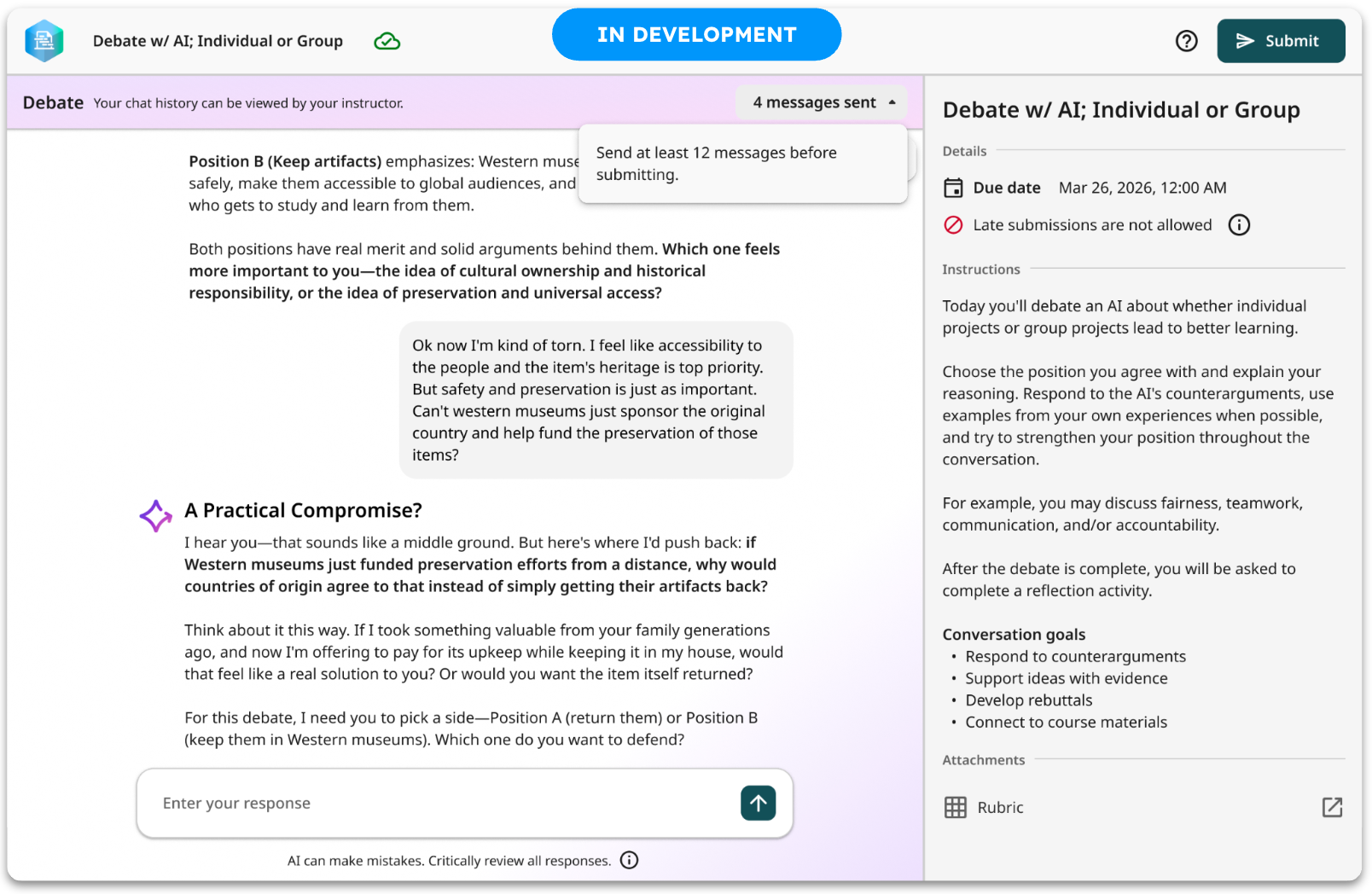
While we're on the subject of AI in assignments, I wanted to give everyone here a sneak peek at a brand new assignment type we currently have in development: AI Activity.
This new assignment type will enhance student learning and engagement through customizable AI-powered activities.
AI Activity empowers instructors to design dynamic, guided conversations between students and a tailored AI, opening up new opportunities for interactive learning.
Instructors will be able to define the AI’s role and personality, provide uploaded materials to inform and direct the conversation, and set clear assignment instructions that align with specific course objectives. Whether it’s a simulated historical figure, a peer reviewer, a coding tutor, or a virtual debate opponent, educators will be able to shape the interaction to drive targeted skill development.
Here is an example of how this will look for student for a debate type of AI Activity. (Notes: Design may not be final & there will be other types of activities available, such as an interview)
We'll have more information to share with you on AI Activity assignments in a few months, but let me know: is this is a way you could see yourself incorporating AI into your students' learning activities?
- Leah, Turnitin Team
-
makes a great point here, and the research supports this approach. Years ago, before I came to Turnitin, I was a middle school principal, and I remember hosting a parent information night about new standards and new assessments students would be taking that year. Many parents came in "hot" prepared to question why teachers were refusing to answer students' questions (which wasn't really the case, but that's how it was perceived). I remember explaining the concept of productive struggle that night, and I used the example of my son who was learning to tie his shoes. Now, when we were late for school and trying to rush out the door, my inclination was to swoop in and tie his shoes so we could GO! I looked around that room, and it was clear that the example resonated with every parent there.
As an educator, I knew I could not shortcut Ben's learning that way. He NEEDED to struggle with the task and experience the feeling of success when he got it on his own. The very process of struggling was where the learning and true mastery would happen.
AI presents a similar struggle now. ANSWERS to simple questions, even whole essays, can be quite easy to get, but that path short cuts the learning. An article in the New York Times today explores this from a research perspective and shows that using AI to outsource the thinking and learning has long term effects that are harmful to learning overall (notice: AI use in general does NOT do this; this effect occurs when the student outsources their own thinking only). This has me thinking deeply about Karen's question of what, exactly, students need to be able to do independently and using that to gauge whether students should use AI for certain kinds of work where productive struggle is actually core to the learning.
The tension, though, is that the research also shows that there are positive effects of using AI to test and stretch one's learning and thinking. We absolutely want students to reap those benefits! It means, though, that some tasks should include the use of AI and some probably should not. The ability to weigh that out and make the right decisions for your students will likely be the defining new skill in instructional practice for the AI age, and having visibility into how students do use AI will be essential.